


Leptospirosis/Weil's Disease
Weil's Disease, also known as Leptospirosis, is rare in Britain with around 40 - 50 cases reported each year, however the disease does kill one or two people every year. It is carried by water organisms, so those taking part in water sports can be at risk.
In the early stages Leptospirosis can be mistaken for flu but can develop into jaundice, kidney and liver failure.
While the risk of contracting the disease from recreational water is very small, British Rowing is taking a precautionary approach and reiterating its advice that the serious nature of the disease means that rowers must be aware of the dangers and should take simple, routine precautions to reduce the risk of infection.
The most likely place for Leptospirosis to be found is in stagnant water, water that is adjacent to farm land and any water where rodents are common.
What are the symptoms?
Typically symptoms develop between 7 – 14 days after infection, although in rare cases the incubation can be as short as 2 – 3 days or as long as 30 days. Some cases may be asymptomatic, some may present with a flu-like illness with severe headache, chills, muscle aches and vomiting.
Many of the symptoms of Leptospirosis are the same as for other diseases and diagnosis is based on clinical suspicion followed by a blood test. There is a specialist reference laboratory for the disease that doctors can consult.
Ways to avoid contracting Weil's Disease
• Wash or shower after rowing
• Cover minor cuts and scratches with waterproof plasters before getting in your boat
• Clean open wounds, such as blisters or calf abrasions with an anti-bacterial substance
• Wear trainers or boots to avoid cutting your feet before getting in your boat
What to do if you think you have symptoms?
• Early diagnosis and treatment is important
• If you develop flu-like symptoms after rowing go to your GP and say that you are a rower
• Leptospirosis is treated with antibiotics which should be administered early in the course of the disease
Further guidance
• NHS Direct http://www.nhs.uk/conditions/Leptospirosis/Pages/Introduction.aspx
• Section 5.3 of Row Safe: a guide to good practice in rowing
http://www.britishrowing.org/news/2010/october/26/leptospirosisweils-disease
Guidance for coached and coach-less Crews
1. No stream to worry about on the lake, but the major hazard is the wind: the lake follows a NW to SE direction from Start to Finish, and there is excellent weather information available on the Met Office or BBC Weather apps. The wind usually blows across the lake from SW or NE. It can blow inexperienced crews on to the bank, or out of their lanes. Crews can also get into difficulties in the corners at the Start. Steersmen and coxes must be alert, and know where the wind is coming from.
2. Congestion is the other major hazard with so many crews afloat for head races and at weekends when the river is on red boards. You must be familiar with the circulation pattern (map posted on the side of the boathouse), use the correct pontoons (outbound pontoons closest to the Return Lake, inbound pontoons closest to the Car Park), and show consideration to other crews.
3. Other crews may not be as considerate, and can get in the way. They will not always alert you to their presence. There is a limit to how many crews a coach can look out for, and a parent on a bike can provide a coach with an extra pair of eyes. The smaller the number of crews to supervise the better on a crowded lake, and it is wise to plan training to keep them close together. Keeping your crews (and others) safe always comes first - before coaching.
4. Dorney Lake is fed from a spring, and is 2-30C colder than the river. In the event of capsize, crews must get out of this water fast - safest to swim to the nearest bank using the boat as a float, and walk out the lake, but remember the wind direction.
Leaving your boat and running back to the boathouse may be the quickest way to get back in the warm. There are hot showers in the changing rooms (up the stairs by reception), and crews should always bring a towel and change of kit because there are many ways that they can get soaked to the skin. Scullers in particular must know what to do in the event of a capsize before they boat.
5. Coaches are expected to carry a throw-bag. You should learn how to use one, and practice regularly. Even if you think that you are pretty useless, there may be someone to help you who can do better.
There is a big yellow rescue boat, but it can take some time to get to a capsize so it is best to find quicker ways to get out of cold water. Do not wait for the rescue boat. It may at least give you a lift back to the boathouse.
6. You are training away from home so re-familiarise yourself regularly with all the relevant RowSafe's guidance on Rowing on Unfamiliar Waters (1.6), Weather & Environment (1.7), and Immersion in Cold Water (1.8).
7. In case of emergencies, make sure that you always have the following numbers saved in your mobile phone:
Dorney Lake reception 01753 832756
Dorney Lake rescue boat 07961 994442
Wexham Hospital A&E 01753 634018
Issue v1.0 14-Feb-2014
Rowing safely at Maidenhead – Induction guidelines
Use same checklist for juniors and adults, but tailor presentation to audience, and invite parent attendance (and appropriate participation).
1. Welcome - a little intro about the sport, the club and safety on the water.
2. Hazard perception (ask them for the list) - best done on the club balcony.
- Emphasise stream/flow rate, wind, cold/rough water, other boats, equipment.
- Explain how we address hazards - yellow/red boards, key navigation rules, maps, night-time and water rowing rules, weather, safety launches, equipment safety checks, emergency procedures, incident reporting, supervision of junior crews, awareness of cruisers and other vessels, every river user's duty of care
- Mandatory safety checks - swim test, capsize drill (what to do if you fall in), importance of washing hands after outings (water-borne disease awareness)
- Reminder that members are required to do their own risk assessment before they go out and are expected to take further appropriate precautions as necessary
3. Boathouse tour - walk round and show first aid boxes, emergency exits etc.
4. Understanding equipment (demo) - participants should be able to name all parts of the boat and oar, understand buoyancy, identify all types of boat, know how to put boat on the water, and back on the rack (tied down) by the end. Check for understanding. Reinforce this learning through L2R & after.
5. How to row - basic sculling technique points (demo), correct grip and posture, paddling, backing-down, squaring, feathering, stopping, turning etc.
6. What to wear, and not to wear, and why (demo) - safety implications, appropriate kit for different weather conditions, recommendations for beginners (low cost and functional) and club crews for racing, parental responsibility
7. Coxing - explain this important role, its responsibilities, equipment used etc.
8. Progression through club from L2R into racing, different squads etc, how the club is run (key officers - Captain, Juniors Captain, Club WSA and Welfare Officer), regattas and head races, key events in the racing calendar, racing at the club, training of all types - how much, how often?
9. What it costs - subscriptions (club and BR) and extras (regatta expenses, rowing kit and equipment)
10. Opportunities to volunteer and make new friends - pitch to parents!
Refer to the MRC Safety Plan, and abridged version (on the club website), along with other safety resources on the MRC website (http://www.maidenheadrc.org.uk/club-safety-mainmenu-138.html), plus British Rowing's RowSafe guidance/minimum standards http://www.britishrowing.org/taking-part/staying-safe/rowsafe)

Issue v1.0 2-June-2014
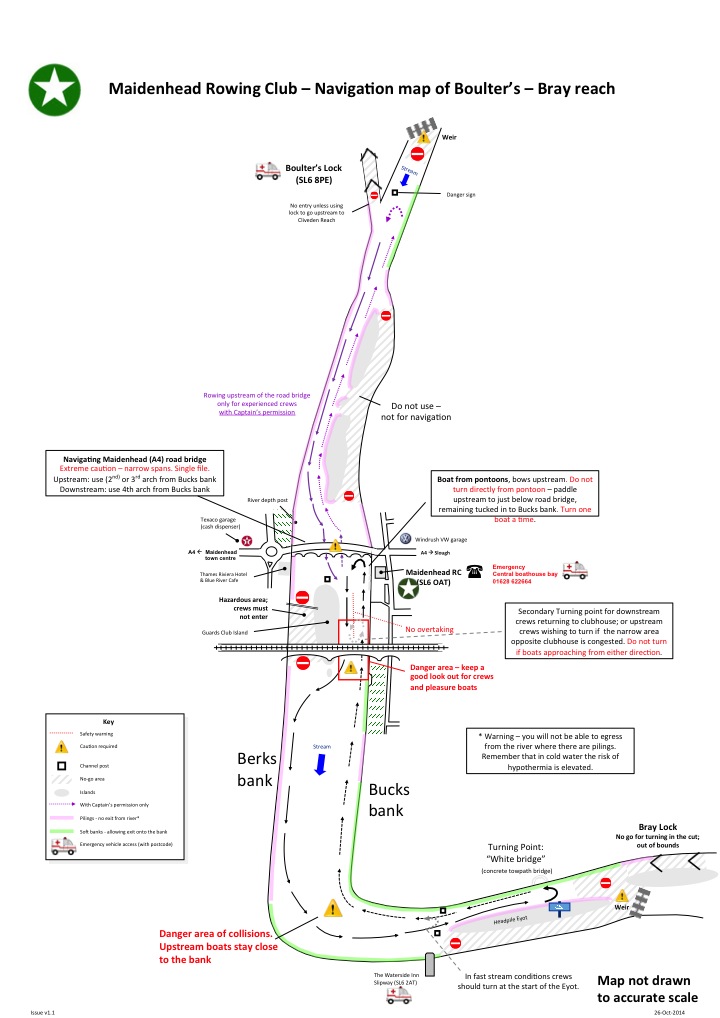
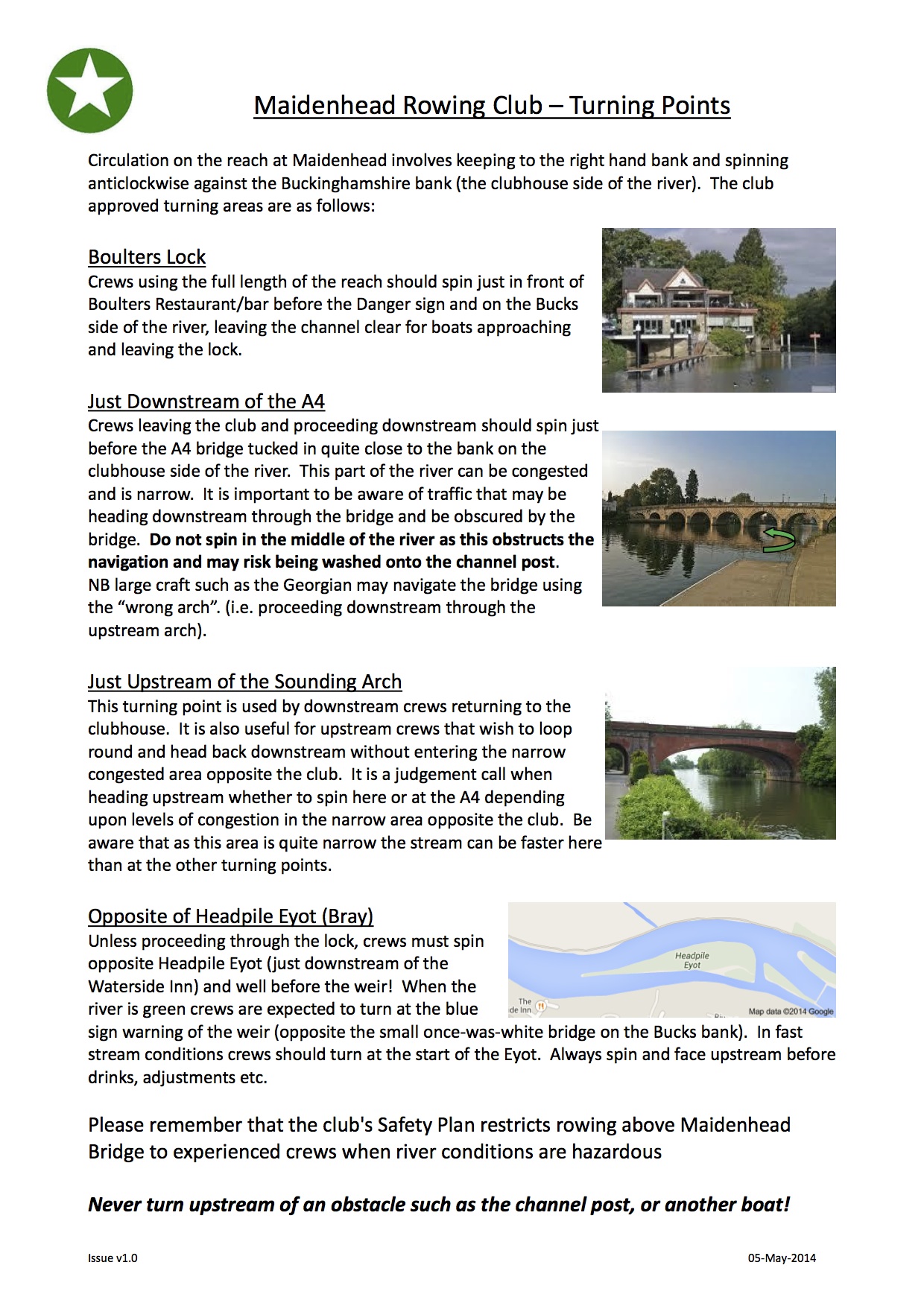
Some guidance for boating safely with cruisers and other large boats:
· Risks to rowing craft from larger vessels include: collisions; swampings; sinkings; and 'getting in each other's way'
· Be aware that you may not be visible to the 'Captain' of cruisers or larger vessels, particularly the double decker 'party' boats that are out during the summer
· Give them a wide berth
· Avoid overtaking when doing a piece (plan your piece between lock batches)
· Be aware that some larger vessels will use the 'wrong' arch on Maidenhead road bridge
· If you have encounter problems, take the name of the boat and report to the lock keeper
· Be polite (e.g. when requesting them to slow down, or cut wash) – most respond positively
Sound signals (from British Rowing Quick Guide to Steering on the Tideway, Feb 2010)
One short blast - I am turning to starboard ie my right
Two short blasts - I am turning to port ie my left.
Three short blasts - I am about to reverse. This is usually followed by one blast or two blasts to show which way the boat is about to turn whilst reversing
Five short blasts - I have no idea what you are doing and I am worried about your position
One Long blast - I am coming but I cannot see fully where I am going!
Subcategories
Safety Briefings Article Count: 5
River Conditions Article Count: 6
Safety Alerts Article Count: 11
Learning from Incidents and Near-misses
We can all learn from others where situations have lead to an incident and hopefully not put ourselves in similar situations, and identify areas of safety needing attention to minimize risk.
Browse the articles categorised below to familiarise yourself with the advice issued by British Rowing and the Maidenhead Rowing Club Safety Committee.


